


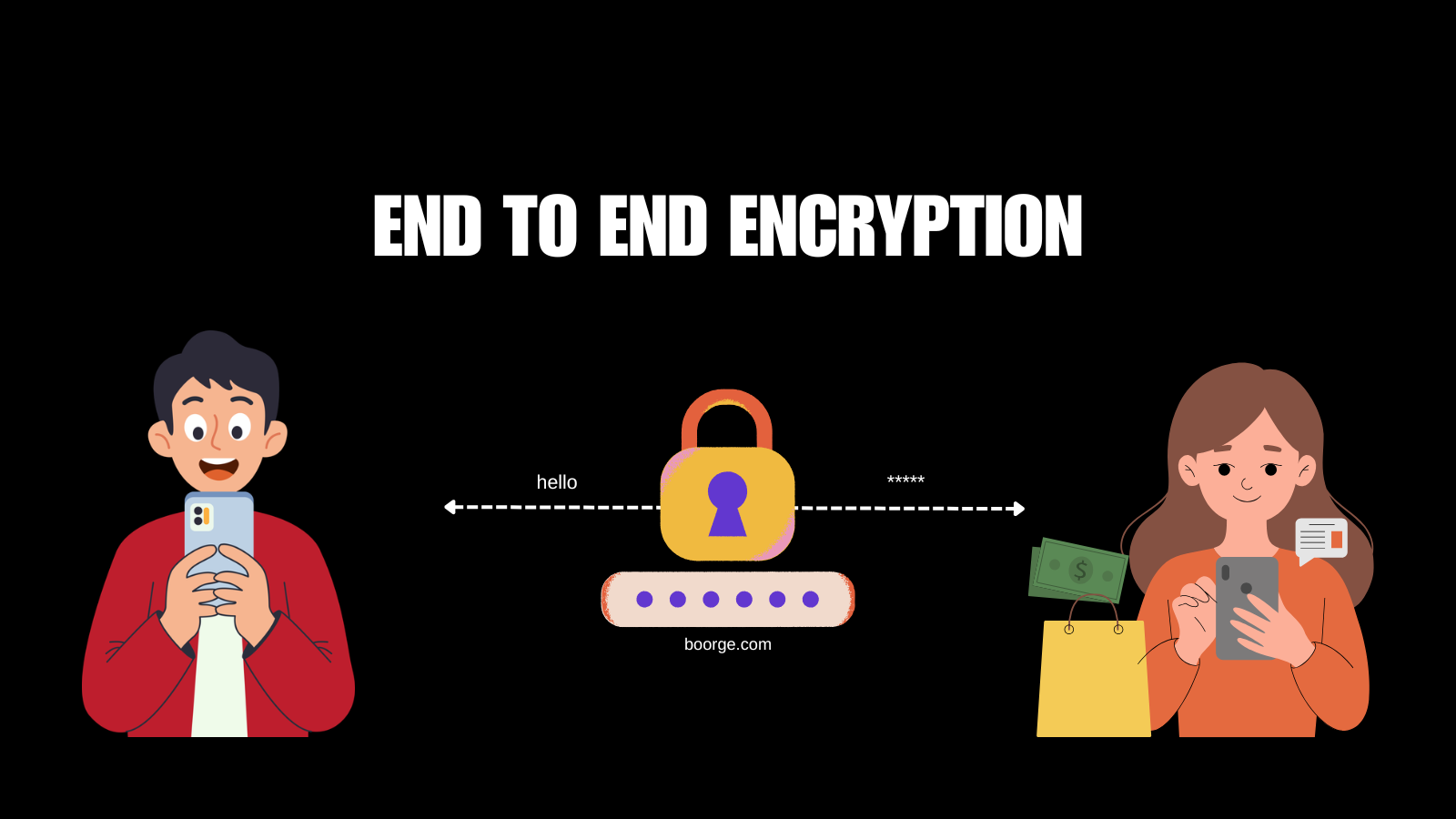
Have you ever sent a message on WhatsApp and wondered, “Can someone else read my chats?” Maybe a hacker, an internet company, or even the app itself? This question comes into almost everyone’s mind today because we live in a world where messages, photos, videos, documents, and even voice notes travel every second through the internet. Privacy is no longer just a technical word. It has become part of our daily life.
Imagine you write a secret letter and put it inside a box. You lock the box and only your friend has the key to open it. Even if someone steals the box on the way, they cannot read the letter. That is exactly how End-to-End Encryption (E2EE) works. It keeps information hidden while it moves from one person to another.
Table Of Contents
- Why Everyone Is Talking About Chat Privacy
- What is End to End Encryption? (What is E2EE?)
- What Does Encrypt Mean?
- How End-to-End Encryption Works
- What Does End-to-End Encryption Mean in WhatsApp?
- Advantages End to End Encryption
- Disadvantages of End-to-End Encryption
- Apps That Use End-to-End Encryption
- Future of End-to-End Encryption
- Conclusion
- FAQ?
Apps like WhatsApp use this technology to protect personal chats, calls, photos, and documents. WhatsApp states that only the sender and receiver can read the messages, and not even WhatsApp itself can access them directly in normal encrypted chats. The system is based on the Signal Protocol, which has become one of the most trusted encryption methods in messaging applications. WhatsApp also protects billions of messages daily using this security approach.
Why Everyone Is Talking About Chat Privacy
The internet has made communication fast. We can send photos from Mumbai to New York in seconds. We can call family members from another country instantly. But speed brings risk. Every message moving online becomes valuable information.
Think about your WhatsApp chats. They may contain bank details, passwords, family photos, office discussions, medical reports, or personal memories. If someone gets access, the damage could be huge. That is why privacy has become a big topic.
Many platforms are now moving toward stronger security systems. Messaging services continue adding encryption features because users want safer conversations. Even platforms beyond WhatsApp have expanded encryption protections over time. Recent developments show that secure communication remains a major focus in technology.
Privacy today is like locking your house door. Years ago people trusted everyone around them. Today we still trust people, but we also use locks, cameras, and passwords. End-to-End Encryption works like that digital lock.
Without encryption:
| Situation | Risk |
|---|---|
| Sending normal text | Easy to read if intercepted |
| Sharing passwords | Information theft |
| Sending documents | Data leakage |
| Private conversations | Privacy loss |
With encryption, the information becomes unreadable during travel.
What is End to End Encryption? (What is E2EE?)
End-to-End Encryption means protecting data between the sender and the receiver in such a way that no third person can read or access it in between.
Let us understand this with a simple example.
Suppose Rahul sends a message to Priya:
“Meet me at 5 PM.”
Without encryption, someone in the middle may read it.
With E2EE:
Rahul’s phone changes the message into a secret code before sending.
Example:
Meet me at 5 PM
becomes
X7A#9LQ21@
While traveling through servers and networks, everyone only sees the coded text. Priya’s phone converts it back into the original message.
This process happens automatically.
It feels like writing a letter in a secret language known only by two friends. Even the post office sees only symbols.
That is why E2EE is called end-to-end:
- One end = sender
- Other end = receiver
- Middle path = protected
This protection is used in many secure communication systems today including messaging platforms. WhatsApp keeps personal messages encrypted by default. Photos, videos, voice notes, calls, and documents also receive protection.
What Does Encrypt Mean?
Many people hear the word Encrypt and think it is something very technical. Actually, it is simple.
Encrypt means converting readable information into unreadable coded information.
Example:
Original text:
“My Password is 12345”
Encrypted version:
“A8F#P2@X9L”
Only someone with the correct key can return it to normal text.
Think of encryption as:
Message + Secret Lock = Encrypted Data
And:
Encrypted Data + Correct Key = Original Message
Here is a simple comparison:
| Normal Message | Encrypted Message |
|---|---|
| Easy to read | Looks like random symbols |
| Anyone may understand | Only authorized users understand |
| Less secure | Highly protected |
Encryption works everywhere:
- Banking apps
- Messaging apps
- Email services
- Cloud storage
- Payment systems
When you use internet banking and see the lock icon in your browser, encryption is working behind the scenes.
In WhatsApp, this process happens automatically. Users do not need to press a special button. Security starts as soon as the chat begins. WhatsApp explains that encrypted chats use special keys available only to participants in the conversation.
How End-to-End Encryption Works
Now let us understand the actual working process in simple steps.
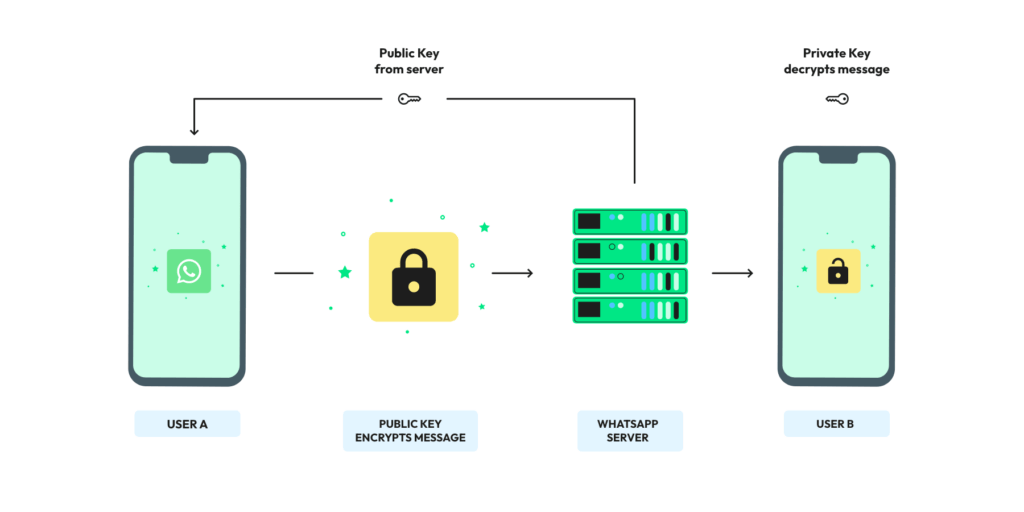
Step 1: Message Creation
You type:
“Hello friend”
Your device immediately encrypts it.
It becomes unreadable coded data.
Step 2: Secure Transfer
The encrypted data travels through:
- Internet providers
- Servers
- Networks
- Data centers
These systems move the message but cannot understand it.
Step 3: Receiver Unlocks It
Receiver device gets the encrypted message.
The device uses a special key.
Message becomes readable again.
Imagine sending a locked suitcase.
Sender locks it.
Courier transports it.
Receiver opens it.
Courier never gets the key.
That is E2EE.
WhatsApp uses cryptographic methods based on the Signal Protocol for this protection system. The company says only participants in the conversation hold the required keys for reading messages.
The beauty of this system is simplicity for users and complexity for attackers. A normal person only sees chat bubbles while advanced mathematics protects everything underneath.
What Does End-to-End Encryption Mean in WhatsApp?
When WhatsApp says:
“Messages are end-to-end encrypted”
It means:
Only:
✅ Sender
✅ Receiver
Can read messages.
Not readable by:
❌ Internet provider
❌ Hackers during transfer
❌ People intercepting traffic
❌ Third parties in transit
WhatsApp applies this protection to:
- Messages
- Photos
- Videos
- Voice notes
- Documents
- Calls
- Status sharing in many cases
The company states that users exchange protected information using encryption keys stored between devices. Security codes can also be checked manually for verification. Backups may additionally use encrypted protection if enabled by the user. WhatsApp introduced encrypted backups so users can secure stored chat copies as well.
Still, people should understand one important point.
Encryption protects message content, but some surrounding information called metadata may still exist, such as timing or contact interactions depending on platform policies.
So E2EE is powerful, but it does not automatically mean complete invisibility on the internet.
Advantages End to End Encryption
End-to-End Encryption gives many benefits.
1. Better Privacy
This is the biggest advantage.
Your conversations remain private.
Family discussions stay personal.
Business information stays safer.
Imagine sending salary reports without protection. That would be risky.
Encryption acts like digital curtains around conversations.
2. Protection From Hackers
Hackers often try to intercept internet traffic.
If data is encrypted, stolen information becomes difficult to understand.
It is like stealing a locked diary without knowing the language.
3. Safe Media Sharing
People share:
- Wedding photos
- Aadhaar documents
- Office files
- Videos
- Audio clips
Encryption protects these items while transferring.
4. User Trust
People use messaging apps because they feel secure.
Without privacy, many users would hesitate before sharing information.
5. Business Security
Companies discuss projects and client information.
Encryption helps reduce exposure during communication.
WhatsApp says its encrypted system protects huge volumes of daily messages across its global user base. Additional encrypted backups provide extra safety for stored conversations.
Disadvantages of End-to-End Encryption
Every technology has advantages and limitations.
E2EE is powerful but not perfect.
1. Harder Message Recovery
If users lose devices and forget backup passwords, recovering encrypted data becomes difficult.
Because strong protection also means fewer recovery shortcuts.
2. Investigation Challenges
Law enforcement discussions often mention encryption because strong privacy can make investigations harder.
This creates debate between:
- Privacy rights
- Security monitoring
3. Metadata Still Exists
Encryption hides message content.
But timing, contact patterns, or usage details may still exist depending on systems.
4. Device Risk Remains
If someone gets your unlocked phone:
Encryption cannot help.
That is why users should also use:
- Screen lock
- Fingerprint
- Two-factor verification
Think of encryption like a strong door lock.
If the house window remains open, security weakens.
So privacy requires multiple layers.
Apps That Use End-to-End Encryption
Several applications use E2EE technology.
| App | Encryption Type | Default? |
|---|---|---|
| End-to-End Encryption | Yes | |
| Signal | End-to-End Encryption | Yes |
| Telegram Secret Chats | End-to-End Encryption | Optional |
| Messenger | Personal chats protected | Default rollout |
WhatsApp remains one of the largest examples.
WhatsApp uses E2EE by default.
Signal is often considered privacy-focused and uses encrypted communication throughout. Community discussions and security comparisons frequently highlight it as a strong example.
Telegram supports encryption in Secret Chats rather than all normal chats.
Messenger expanded default encrypted protection for personal chats.
Different apps implement security differently, so users should understand settings before assuming everything is automatically protected.
Future of End-to-End Encryption
The future looks interesting.
People want more privacy.
Governments want safety.
Technology companies try balancing both.
We may see:
- Stronger encryption
- Better backup systems
- Safer cloud storage
- Advanced identity checks
- AI-assisted protection
Recent industry updates show more platforms adopting stronger encrypted communication methods, proving that secure messaging is becoming standard rather than optional.
Privacy online will probably become as important as passwords are today.
Years ago nobody talked about E2EE.
Today millions use it daily without noticing.
Tomorrow it may become part of every digital service.
Conclusion
End-to-End Encryption may sound complicated, but its idea is simple.
It protects conversations between two people.
Only sender and receiver can read the message.
Encrypt means changing readable information into secure coded text.
In WhatsApp, E2EE protects chats, calls, photos, videos, and documents automatically. It works quietly in the background while users simply continue chatting.
Think of it like sending a locked treasure box through a crowded road. Everyone sees the box, but only the person with the key can open it.
That is the power of End-to-End Encryption.
FAQ?
Read more:
- What Is My IP Address? Find, Check & Understand Your IP
- How to Buy a Domain Name (Step-by-Step Guide) | How to Buy Domain from GoDaddy
- What is a Proxy Server? Complete Guide to Proxy Servers, Types, Uses, Working, Risks, and Setup
- Create Portfolio Website using React
- What Is End-to-End Encryption? How WhatsApp Keeps Chats Secure